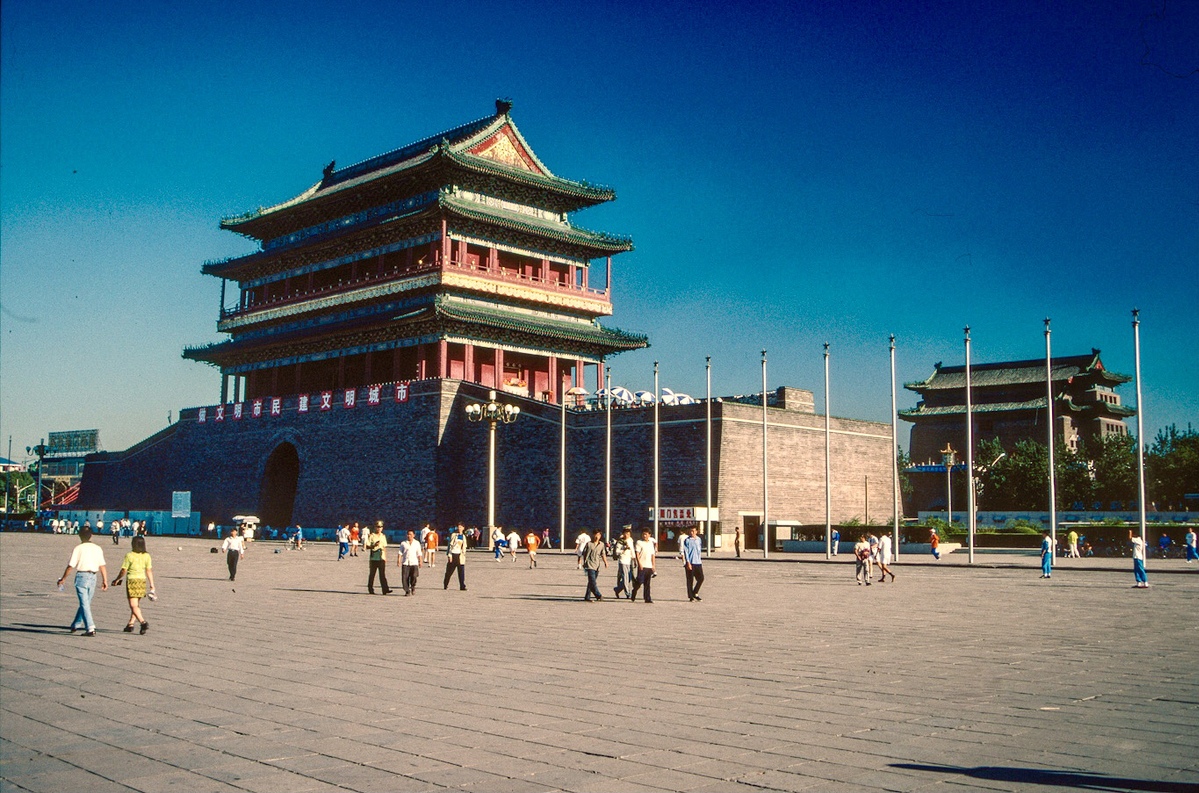
Zhengyang Gate
Introduction
Zhengyang Gate, also known as Qianmen, is a prominent historical landmark located at the southern end of Tian'anmen Square in Beijing. Originally constructed during the Ming Dynasty (1368-1644), it was one of the nine gates that guarded the inner city of Beijing. It was rebuilt in 1906, reaching a height of 43.65 meters. Today, it stands as a significant cultural and historical site, forming an integral part of the Beijing Central Axis. This axis is a 7.8-kilometer-long north-south line that runs through the center of the historical neighborhood, following a symmetrical layout.
Architectural Details
The architecture of Zhengyang Gate reflects traditional Chinese design, featuring red walls and green tiles, which are commonly associated with Beijing's historical buildings. The gate, strategically positioned on the Beijing Central Axis, plays a crucial role in shaping the spatial pattern of the ancient city. This axis, outlined initially by Kublai Khan, the founder of the Yuan Dynasty, was further developed during the Ming and Qing (1644-1911) dynasties, ingeniously arranging the location of imperial palaces, temples, altars, and marketplaces.
Cultural and Modern Influence
Zhengyang Gate is not just a historical monument; it is ingrained in the cultural narrative of Beijing. As a part of modern explorations, it is included in theatrical productions and cultural events. The dance drama "Weiwei Zhengyang" performed by students and teachers of the Beijing Dance Academy, showcases the gate's historical significance. This production spans five generations of a family, capturing key periods in Chinese history while highlighting the architectural and cultural importance of Zhengyang Gate.
Preservation Efforts
Efforts to preserve Zhengyang Gate and the Beijing Central Axis are ongoing, with legislative measures and public participation playing vital roles. Local government regulations and initiatives focus on safeguarding the cultural heritage of the area, encouraging public involvement in conservation activities. The historical significance of Zhengyang Gate, combined with its cultural symbolism, ensures that it remains a cherished part of Beijing's architectural and historical legacy.








